
ANSWER VERIFICATION / JAPAN
the Jag Uradori System
Check the Japanese answers of the AI your team already uses.
Compare answers with current official information, before and after launch. Built around the journalistic practice of checking a claim against another source.
Contact Jag ProjectFor teams responsible for answers in Japan
- Municipal disaster-preparedness, service-counter and digital teams
- Corporate operations, IT and customer-support teams
- AI developers and implementation partners seeking an independent review
- Overseas companies with Japan offices, or planning a Japan launch
Your questions. Jag Project’s support.
Nobody checks the Japanese answers of the AI already in use.
What Jag Project providesJag Project defines questions and scoring criteria with the organization before measurement, scores answers with their conditions concealed, and reports discrepancies and suggested fixes.
A general accuracy figure does not explain performance on local tasks.
What Jag Project providesThe review uses the Japan office’s own questions and references, including questions that should not be answered from the available material.
The team needs a repeatable way to verify answers before and after launch.
What Jag Project providesJag Project documents the scope, sources, criteria and procedure so later checks can be compared. The service is not a certification of legal compliance.
The AI confuses local offices, phone numbers, opening hours or deadlines.
What Jag Project providesJag Project organizes verified official or organizational facts item by item, with a source URL and check date for each item.
Answers remain unchanged after official information is updated.
What Jag Project providesJag Project reviews the agreed sources and identifies affected answers, FAQs and documents. Frequency and operational responsibilities are agreed separately.
Users cannot trace the answer to a source or a useful contact.
What Jag Project providesReference items include source URLs and check dates. Response rules identify where to ask when information cannot be verified.
Refusing too often is unhelpful, but guessing is unsafe.
What Jag Project providesJag Project defines which facts can be answered and which need a referral, reviewing both the tendency to decline and the usefulness of the next step.
Existing FAQs and handouts may be out of date, even without AI.
What Jag Project providesJag Project compares the existing material with current official information and lists outdated or unsupported items. No AI deployment is required.
Built for travel emergencies, tested on disaster-preparedness questions
Jag Project has sold travel SIM services since 2014. In October 2026 it launched Travel AI Rescue, an assistant included with its travel eSIM that tells travelers what to do next when a phone is stolen, someone falls ill or the connection fails. A single wrong embassy or police number in that situation leaves a traveler stranded.
To prevent that, the company built a sequence of checks around the AI, modeled on uradori, the practice among Japanese reporters of confirming a fact against a second source before publishing. The Jag Uradori System offers the same sequence to organizations outside travel. It works with the AI an organization already uses.
- 0 vs 14 to 18: Across 74 questions on country-specific contacts and procedures (September 22, 2026), Travel AI Rescue gave 0 answers that contradicted official information; three publicly available chat AIs gave 14 to 18. Travel AI Rescue answers from verified reference material, so the conditions were not the same.
- 16 to 0: In 30 disaster-preparedness questions about two Tokyo wards (October 2, 2026), answers that contradicted official information fell from 16 to 0 when the checks were applied to the same AI. Questions, correct answers and scoring rules were recorded before any answers were collected, and answers were scored blind.
- 51.4% to 93.8%: Share of key points included in answers to the 24 questions about Koto Ward.
One publicly available chat AI also had 0 contradictions, but declined to answer 20 of the 30 questions. Where no verified material existed (6 questions about Edogawa Ward), the checked answers covered only 9.7% of key points, because they do not state facts that cannot be verified. Each of those answers named the office to ask instead.
- Whitepaper (Japanese, published October 7, 2026): https://panam.travelsim-japan.com/jp/research/
- Travel AI Rescue for businesses (Japanese): https://panam.travelsim-japan.com/jp/business/rescue/
What the diagnosis leaves with your team
- An agreed list of questions and reference material
- A report of contradictory, missing or unsupported information
- Suggested reference and response-rule changes, with next checks
Scope and conditions are agreed separately.
Studies conducted by Jag Project. Answers were scored by AI raters without memory of earlier answers, blind to which system produced each answer. The other AIs are not named.
The verification process
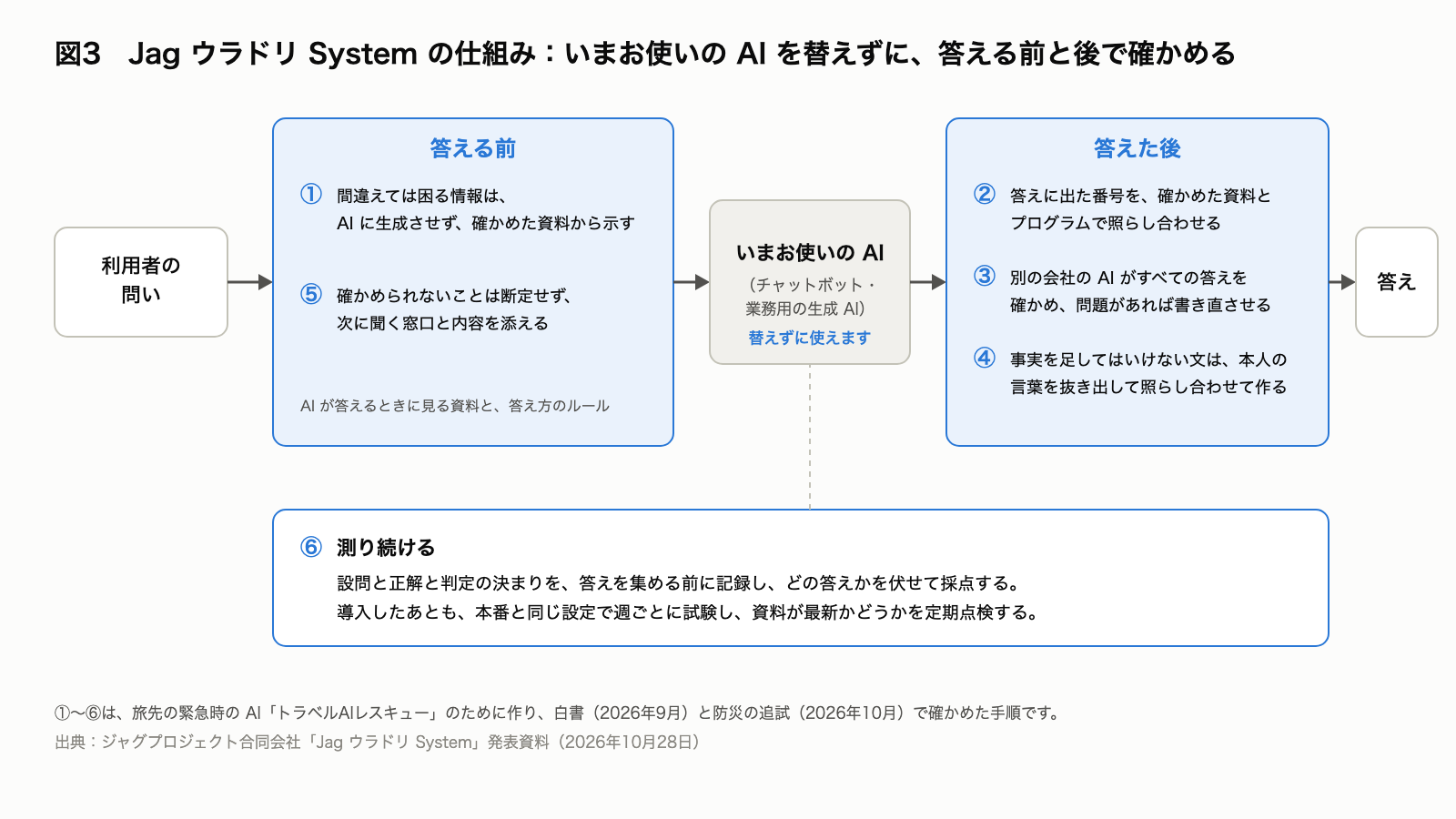
Improve the references and rules around the AI.
Wrong-answer diagnosis
Check the current AI against the organization’s own questions and references. Receive a report of discrepancies and suggested improvements.
References and response rules
Organize contacts, hours, conditions and procedures with source URLs and check dates. Define where to direct users when a fact cannot be verified.
Updates and repeat checks
Review changes to official information or internal rules, identify affected items and repeat the agreed checks after launch.
FAQ and document review
Start with existing FAQs and distributed documents, even where generative AI is not in use.
From diagnosis to repeat checks.
Define the checks first
Agree on questions, reference material and the information each answer needs. Specify what to do when an answer cannot be verified.
Record and compare answers
Record answers from the existing AI without changing it during measurement. Compare them with sources and use scoring that conceals the answer conditions from evaluators.
Report what needs attention
Identify contradictions, missing information and unsupported statements. Use these findings to improve reference material and response rules.
Check again after changes
Repeat the agreed checks after source or operational changes and compare with previous results. Agree separately on the scope and frequency of ongoing checks.
A checkable answer, not just a confident one.
The approach combines verified reference material, software checks for numbers, a separate AI check and rules for directing users to a source when a fact cannot be verified. Evaluation criteria are defined before measurement.
Read the background: why AI answers in Japan need a second-source check
Before getting started.
Does the existing AI need to be replaced?
Diagnosis starts with the AI already in use. Changes to its reference material or response rules depend on the existing system and agreed scope.
What does the diagnosis provide?
A report of discrepancies, missing information and unsupported answers within the agreed questions and references, with suggested improvements.
Does this guarantee correct answers?
No. The aim is to reduce wrong answers and make continued checking possible. Reports state the scope and conditions of evaluation.
How is the work priced?
A quotation follows a review of the target tasks, documents, system and required support.
Start with the answers your team needs to trust.
Describe the task, the AI or FAQ currently in use, and the answers causing concern. Jag Project can help define what to check and which sources to use.
Contact Jag ProjectHeading icons are AI-generated supporting images. The logo and process diagram use the supplied original assets.